kakobuy Salomon Trail Shoe Spreadsheet Guide
kakobuy Salomon Trail Shoe Spreadsheet Guide
This guide solves a specific problem: when faced with similarly named, parameter-incomplete Salomon trail shoe listings in the kakobuy Spreadsheet, how to narrow down candidates based on terrain, foot shape, outsole, and QC evidence.
After reading, you can build a sourced candidate table with missing items marked, and decide which shoes are worth submitting an order for, which need confirmation from the seller, and which should be excluded outright. This article is not suitable for judging authenticity, nor can it replace trying on shoes, long-term durability testing, or professional sports injury advice.
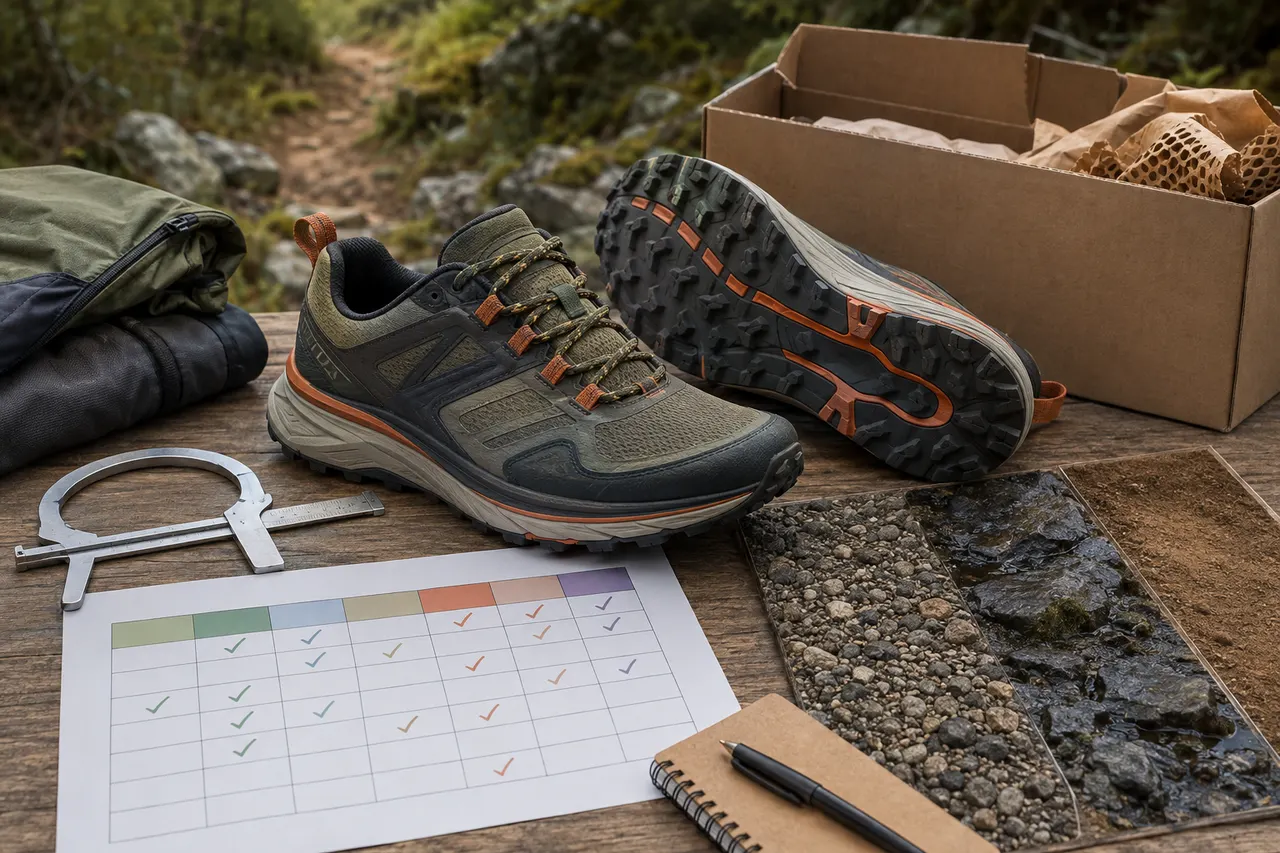
Figure: Organize candidate shoe models from four dimensions: terrain, last, outsole, and warehouse QC.
Determine Terrain Type, Distance, and Foot Shape Needs First
Don't filter shoes by colorway or seller hype first. Record the terrain you run on most often, typical distance, and foot shape restrictions. These three conditions will directly influence subsequent judgments.
You can start by writing down:
Primary terrain: hard gravel roads, soft muddy ground, forest trails, rocky surfaces, or mixed road and trail sections.
Common distances: short daily training, medium-to-long distance training, or long hikes and trail activities.
Foot shape needs: wide forefoot, high instep, heel slippage, or different left/right foot lengths.
Known issues: toe jamming on downhills, toe box pressure, arch discomfort, or lack of confidence on wet surfaces.
Must-meet conditions: acceptable weight range, upper protection, size allowance, and budget cap.
If your usage spans multiple terrains, determine the primary scenario with the highest proportion, rather than seeking a shoe that is "best" under all conditions. Trail shoe selection is essentially a trade-off: more pronounced lugs may not be suitable for long time on hard ground, and thicker protection may increase weight and stuffiness. 🏃
What the kakobuy Spreadsheet Can Provide and What It Cannot Prove
kakobuy's platform positioning is to assist users in purchasing goods from Chinese e-commerce platforms, and to provide warehouse inspection, parcel handling, and international shipping services. The Spreadsheet is more suitable as an entry point for discovering products and organizing candidate links, rather than as a product authenticity or performance test report.
Table entries may help you find product names, colors, labeled sizes, seller pages, or price records, but cannot alone prove:
The product is definitely an official Salomon genuine item.
The last is exactly the same as the official model of the same name.
The outsole rubber compound, cushioning structure, or waterproof performance matches the claims.
The page inventory, price, and sizes are still valid.
The product fits your foot shape or a specific race.
Prices, inventory, sellers, sizes, return/exchange conditions, and link status may change. The platform information in this article was recorded on September 3, 2026; before submitting an order, you should still re-check on kakobuy and the original product page. If a listing has only images, abbreviations, or an inaccessible source page, mark it as "insufficient evidence" and do not fill in parameters based on the title. 🔎
Build a Candidate List Based on Series Positioning and Product Page Specifications
Keep only those entries that can open the original product page and that have clear product names, size options, and recognizable product images on the page. Links that have jump errors, blank pages, pure category pages, or information that cannot correspond to a specific product should not enter the final candidate list.
Do not infer the shoe's purpose solely from the series name. Even if names are similar, different versions, years, or seller batches may have structural differences. Treat the series name as a search field, and the visible specifications on the product page as current evidence.
It is recommended to build a candidate table with the following fields:
Field | Evidence to Record | Handling When Missing |
|---|---|---|
Listing name and source | Spreadsheet name, original product page name, page status | Exclude if names cannot be matched |
Terrain clues | Page description, complete outsole image, upper protection structure | Do not judge based on vague promotional words |
Size information | Seller size chart, insole length or inner length, units | Request seller to supplement |
Version identification | Tongue label, product code, packaging label, or page model number | Mark as unconfirmed |
Current price and stock | Order page display result and verification date | Re-check before ordering |
Risk record | Image inconsistencies, parameter conflicts, return/exchange restrictions | Do not submit if conflicts unresolved |
If a product page puts multiple versions under the same link, record each specific color and size variant separately to avoid mistakenly applying the main image information to the selected variant.
Verify Size Charts, Last Clues, and Toe Box Space
Size numbers do not directly represent actual internal space. When screening, prioritize looking for centimeter-based foot length recommendations, insole length, inner length measurement methods, and applicable size chart versions. Do not convert between EU, US, and centimeter markings without a brand-specific conversion chart.
A safer approach is:
Measure both feet while standing and bearing weight, and use the longer side as the base record.
Record the widest part of the forefoot and instep characteristics, not just shoe size.
Check whether the product page size chart indicates whether the data represents foot length, insole length, or internal shoe length.
Use the insole length of your current well-fitting athletic shoes as an auxiliary reference, but do not assume internal space is consistent across different shoe models.
Make specific requests for additional photos or measurements when data conflicts exist.
QC photos can usually show the size label received, but cannot prove wearing comfort. If you have a wide forefoot, focus on the toe box outline, lace area width, and where the upper narrows; these can only serve as clues, not replace actual trying on. 👟
Compare Outsole Coverage, Lug Pattern, and Upper Protection Structure
When comparing outsoles, request a full frontal view of the entire sole. Do not judge grip ability based on partial close-ups or product names alone.
Key things to record:
Whether rubber coverage extends through the forefoot and heel, or if there are large exposed midsole areas.
Whether lug direction, spacing, and distribution are clear and consistent between left and right shoes.
Whether there are abnormal cracks, missing rubber, or obvious deformation near the forefoot flex zone.
Whether the toe cap has visible protective structure, and whether key upper areas have reinforcements.
Whether the heel structure is symmetrical and the outsole and midsole edges are well bonded.
Photos alone cannot confirm rubber hardness, wet-surface friction, cushioning degradation, or actual wear life. Therefore, in the article and candidate table, use observational statements such as "visible coverage relatively complete" and "lug spacing discernible," and avoid writing "excellent slip resistance" or "suitable for all complex terrains."
Check Left/Right Shoes, Bonding, and Key Markings from QC Images
After the product arrives at the kakobuy warehouse, the goal of QC is to verify visible appearance information, not to perform professional performance testing. According to existing platform information, routine inspection mainly checks style, quantity, color, size, model, and other appearance items; the specific scope of service and additional photos that can be requested should be based on the order page.
When viewing QC images, check in order:
Whether left and right shoes match in color, lug pattern, laces, and upper stitching.
Whether tongue size labels, product codes, or other key markings are clear and correspond to each other.
Whether there are large areas of separation, abnormal glue overflow, or obvious misalignment at the midsole-outsole seam.
Whether the toe box, heel, and collar have crush damage, breakage, or irreversible deformation.
Whether accessories, insoles, and packaging match the order selection.
Minor glue marks should not be confused with structural separation. If existing angles are insufficient for judgment, request close-up supplementary photos instead of immediately drawing quality conclusions. Screenshots used for consultation should cover names, addresses, order numbers, and payment information. 📷
Record Missing Parameters, Source Links, and Supplementary Photo Requests
For every unconfirmed field, leave it blank or write "not provided"; do not substitute data from similar models. It is advisable to save the verification date, information source, and conflict notes simultaneously, so that subsequent return/exchange communication can be traced.
Supplementary photo requests should be specific and actionable, for example:
Please take complete frontal views of the outsoles of both left and right shoes separately.
Please take close-up photos of the tongue size labels of both shoes.
Please measure the length of the removable insole from the center of the heel to the farthest toe position, with the ruler fully visible.
Please take additional front and side photos of the suspected separation area.
Please confirm which pair of shoes corresponds to the selected color and size in the order.
According to the platform information in the prompt, some products may have return/exchange restrictions, and the warehouse processing window is time-sensitive. The general return/exchange window recorded in the information is 120 hours after warehousing, but special products, restricted items, and products where removal of packaging, tags, or accessories has been requested may not apply. This information is highly volatile policy and must be based on the actual order page, product conditions, and customer service responses after September 3, 2026. Submit evidence as early as possible when problems are found, do not wait until preparing for international shipping.
Next Step: Keep Final Candidates Based on Fit Evidence
The final screening should not aim for the most candidates, but keep the few entries with the most complete evidence chain. Decisions can be made in the following order:
Delete entries with dead original product pages, unclear names, or unidentifiable versions.
Delete entries where size basis clearly conflicts with foot shape needs.
Submit inquiries for entries with insufficient outsole, upper, or label evidence.
After the product is warehoused, use QC images to verify that the selected variant matches the actual received item.
Resolve issues such as size label errors, serious appearance defects, and left/right shoe mismatches within the return/exchange window.
Only proceed to consolidation and international shipping line selection when all key evidence is complete.
This method may save product costs and subsequent shipping fees caused by wrong size, dead links, or obvious appearance issues, but cannot predict a fixed saved amount in advance. The added costs are organization time, possible supplementary photo fees, and time-sensitive risks from waiting for confirmation.
It is suitable for users who are willing to screen item by item based on page and QC evidence, and who can accept the uncertainty of cross-border purchasing; it is not recommended for users who cannot confirm size, need guaranteed official authenticity, must rely on trying on, or cannot bear return/exchange and international shipping risks.
Content note: This article was generated by an automated editorial process based on structured platform information and a reviewable screening method, and does not claim that the author personally purchased, tried on, or tested any shoe model. All dynamic policies, product parameters, and order conditions should be re-verified on the day of operation. ✅
Agent Platform Shopping FAQ
1. How can I find the product I intend to purchase on kakobuy?
You can look up items on kakobuy using one word, or head straight to a category page where products are grouped by brand. Searching with longer phrases often yields fewer results than shorter ones, but they tend to be more targeted. For instance, you could search for "Air Force 1 White," "sneakers," or just "Air Force 1."
2. What should users who are new to agent services through the spreadsheet on kakobuy pay attention to?
Users who first reach a Taobao agent through kakobuy's spreadsheet normally get a newcomer shipping discount gift set. At the same time, you should check the step-by-step shopping tutorial for beginners.
3. Is the spreadsheet website used by kakobuy safe and reliable?
This website gathers no personal data whatsoever; it functions only as a product listing for kakobuy. All purchases are handled on the kakobuy platform itself.
4. What should I do if the product I receive on kakobuy does not meet my expectations?
You should get in touch with kakobuy's customer support without delay. For most non-specialty goods bought from Chinese sellers, there is a 5-day no-reason return and exchange policy. If you are unhappy, you may ask for a return. In case the product has already left the warehouse and reached you, and you find a quality problem, you must contact kakobuy's support team so they can assist you in communicating with the merchant to work out a compensation plan.
Below are the customer service email addresses for each platform:
kakobuy: [email protected]
oopbuy: [email protected]
usfans: [email protected]
hipobuy: [email protected]
superbuy: [email protected]
Browse our latest products and find your next favorite item.